
We Are Mapping the Climate Justice Landscape of Boulder County
For the past few years, the Climate Justice Hive has been researching the climate justice landscape of the county and building database of organizations and programs with dozens of fields, tags and values showing the focus, approach, locations, demographics, goals, and more. We are currently building a dashboard is designed to assist orientation to our shared ecosystem of organizations, institutions, local governments, congregations, and community/ies, in our collective efforts for a better Boulder County and a more just, sustainably nourishing, shared world.
Our Agreements:
1. Prioritize Underrepresented Voices: Elevate the leadership of communities disproportionately affected by climate change.
2. Collaborate Courageously: Work together boldly, sharing knowledge and resources to develop comprehensive solutions.
3. Pool Resources: Combine financial, technical, and human resources to maximize impact.
4. Empower Community Based Actions: help make sure they are supported and well resourced.
5. Plan Long-Term: Set practical milestones for 2030 and 2040, regularly updating plans for collective action.
6. Embrace Learning: Continuously learn and adapt, sharing best practices and insights.
7. Foster Empowerment: Create a supportive environment where all individuals feel valued and motivated.
8. Celebrate Successes: Celebrate achievements and view challenges as opportunities for growth.
9. Monitor Progress: Define measurable goals, evaluate progress, and communicate openly.
Mapping Lenses or Dials
The following dashboard tabs are the lenses through which we can view the entire landscape, or dials with which we can measure impact and opportunity.
“Who?” | Positionality Dial
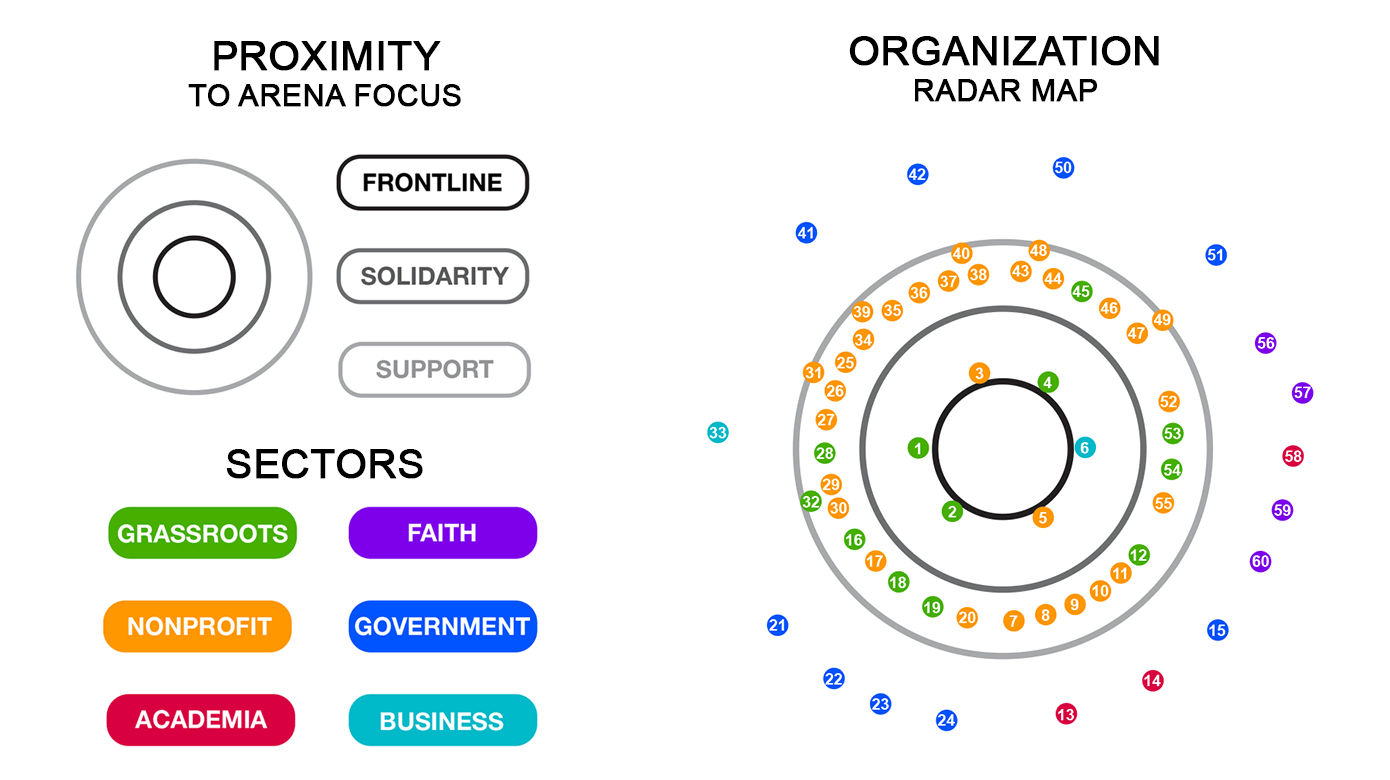
Providing a view into the positions, identities, and alignments of each of the players on the board in Climate Justice efforts. This is primarily filtered by Proximity to the on-the-ground work and the Sector down to the organization or program level. The goal is to breaking down siloed conversations about Arenas (e.g., Government, vs. etc.) to bring folx into the same room, sharing knowledge, data, and resources.
“What?” | Arena Efforts Dial
The focus area an organization works within, identifying relevant active and potential collaborators working in the shared space grounded on related practices, issues, and strategies. The goal is for all boats to rise in a shared space, regardless of specific campaigns, efforts, etc.

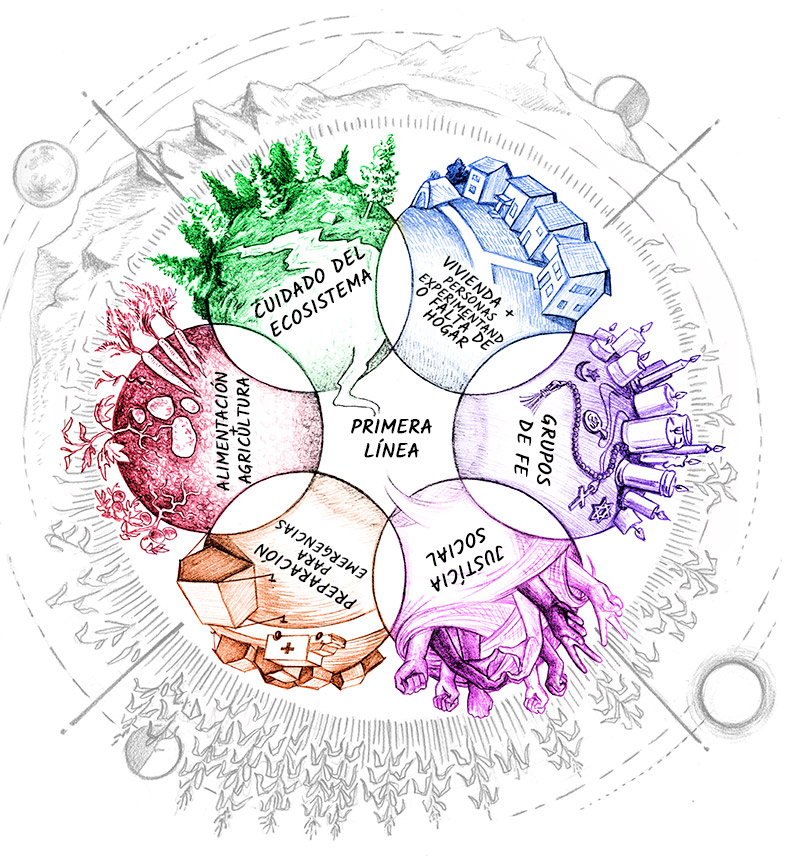
this diagram looks at an example six arenas which intersect in the focus of Social Justice
We are currently tracking about 40 different arenas representing different focus areas within Climate Justice in Boulder County including Circular Economy, Transportation, Energy, Water and Air, Pollinators, etc.
“Where” | Impact Maps Dial
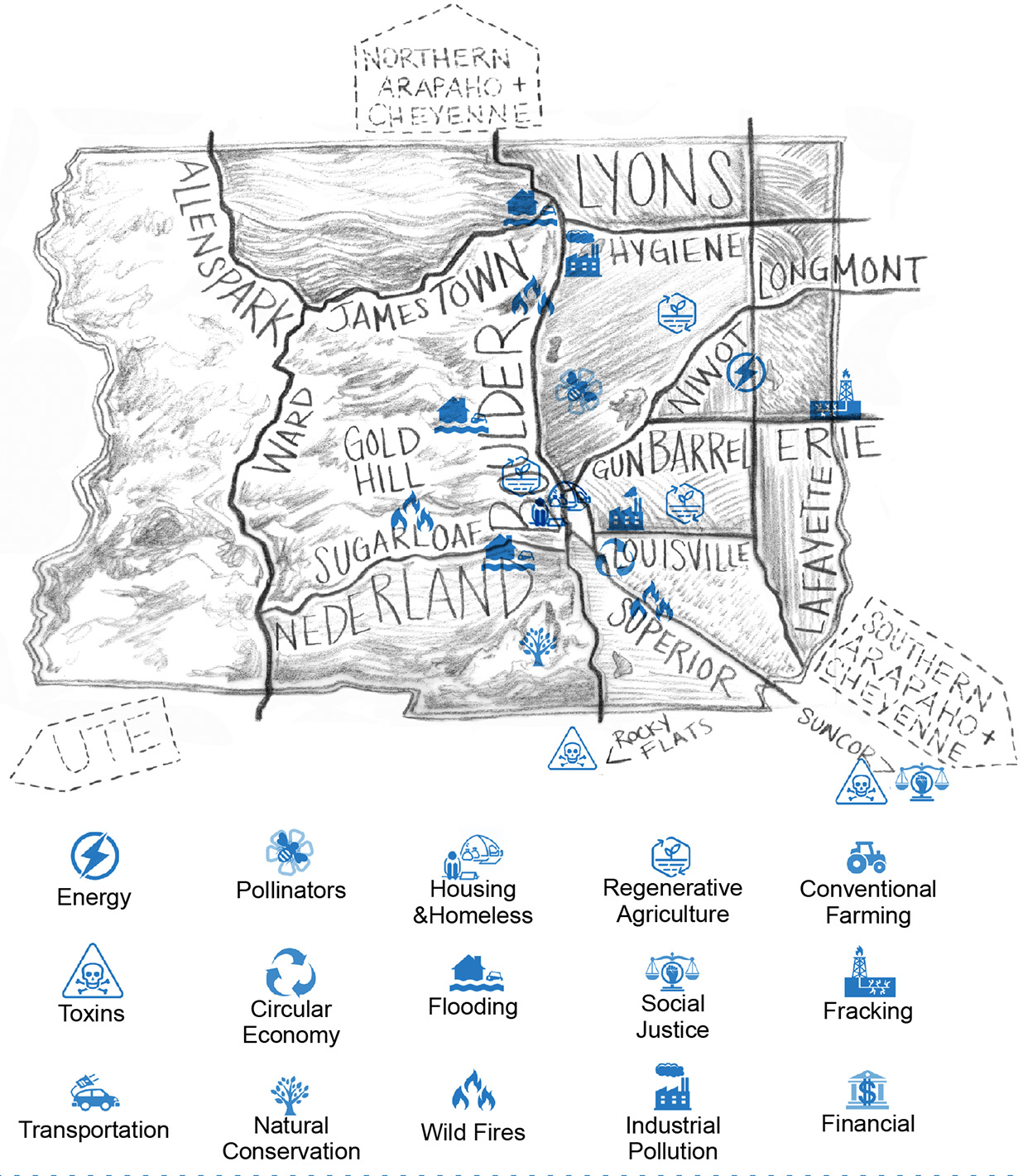
Users see an interactive map of their area that provides 3 distinct views:
Available Services: A view of the organizations that work in (& don’t) specific areas, including the skill sets provided.
Active Campaigns: A view of campaigns going on within selected Arenas and with your associated Collaborations in those puzzle pieces
Organization Addresses: A view of the logo located at the organization’s headquarters – on hover, a profile displays with critical information such as the point of contact, skill sets, and arenas.
This map would interact with page-level filters based on organizations’ principles, sectors, arenas, and more.
This map should create “puzzle pieces” outlines shaped by the community. This would support self-identification by organizations and collaborations of the “neighborhoods” where each does work. This work would initially be focused on their organization as a whole. In the future, this could include breakdowns by each of their selected Arenas and Campaigns.
“When” | Benchmarks Dial
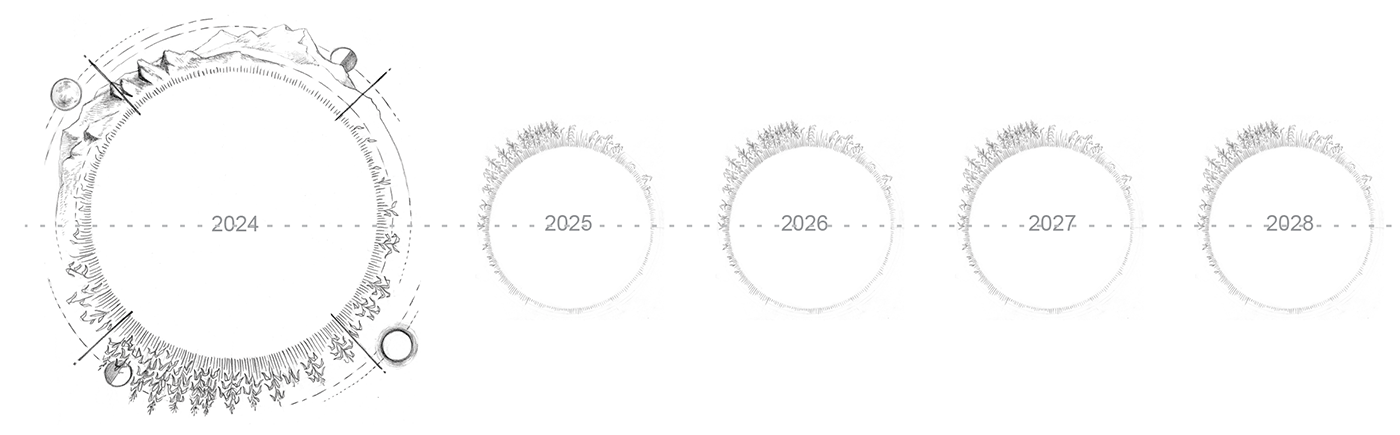
This is the central location for sharing and viewing plans at the Network level. It will display vision benchmarks that more than one organization will collaborate on. This will focus on the arena and campaign levels. Ideally an organization will break down these visions into specific goal benchmarks that multiple organizations can collaborate on for 7 years ahead.
“Why?” | Fundamentals Dial
The reasoning or analysis that explains why the organization is using its approach, skillsets and business model to address the issues (i.e, the injustices, principles, and research) that drives work in the impacted communities’ landscapes. This ideally should help differentiate an organization or their work from others in the arena.